
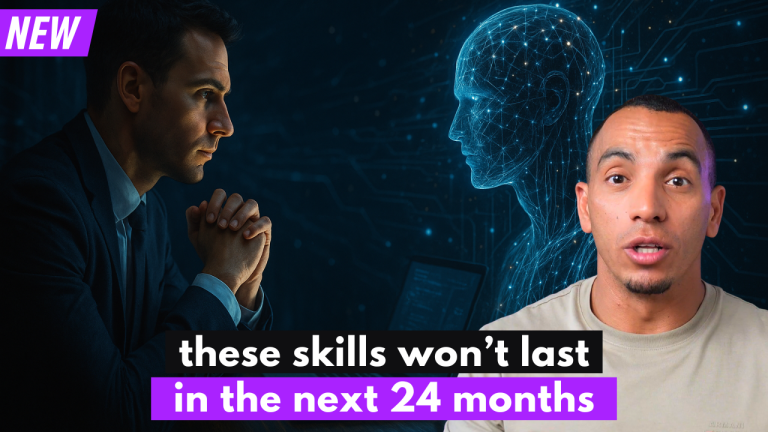
Here’s what keeps me awake at night. We are stepping into a future where artificial intelligence will not just change how we work, it will change how we talk, how we listen, and how we understand each other as humans. If we let AI write our words, speak our ideas, and even mimic our emotions, what happens to us? Do we slowly lose the very skill that makes us human?
George Bernard Shaw once said, “The single biggest problem in communication is the illusion that it has taken place.” In an age of AI and social media, that illusion is more dangerous than ever. We might think we’re connecting, but are we really?
The future is coming whether we like it or not. AI will become smarter, faster, and more present in every part of our lives. We can’t resist it, and nor should we, but we must prepare for it. And the way to prepare isn’t just by learning new technology. It’s by doubling down on the one thing machines can’t replicate: authentic, human communication. And here’s the bigger concern: what about our kids? Your kids, my kids, the next generation. If they grow up in a world where screens and machines do the talking for them, how will they learn to truly connect? To negotiate? To inspire? To lead?
I came across a claim that Millennials are afraid to speak with tradespeople. I couldn’t find any evidence to support it, so I’d treat that with scepticism. What is true, however, is that Gen Z tradespeople prefer face-to-face interaction despite growing up digital, with 81 percent choosing on-site conversations over text or email. On a broader level, phone anxiety is real: only about 16 percent of Millennials and Gen Z see phone calls as a valuable form of communication.
So what do we do? How do we prepare ourselves, our kids, and our workplaces for this reality? The answer is simple: we invest in communication. Not tomorrow. Not someday. Now.
We live in the real world, and communication has real consequences. It shapes your career, your relationships, your confidence, and even your income. That’s why I often draw on history, because it proves that the right words, spoken at the right time, can change the course of nations. And today, in a world being redefined by AI and social media, those same principles apply to your life, your work, and your future.
History shows us that one skill has changed the destiny of nations, shaped revolutions, and built legacies, and that skill is communication. The ability to move people with words and presence has always separated those who lead from those who follow. But today, as AI advances faster than ever before and social media redefines human connection, communication has never been more important, or more at risk.
I’ve spent my career working with leaders, professionals, and high performers to master the art of communication and negotiation. And I need to tell you something that may sound uncomfortable: if we don’t act now, we risk losing one of the greatest human powers we’ve ever had. But here’s the hope, this is also the greatest opportunity of our lifetime, if we’re willing to invest in ourselves and the next generation. Communication has always been humanity’s greatest weapon and greatest gift. Wars have been won and lost because of it. Civilizations have risen and fallen because of it. The ability to influence, to inspire, to persuade, that is what moves the world.
Take the Cuban Missile Crisis of 1962. The world was holding its breath. Nuclear missiles were pointed, soldiers waited for the command, and families on both sides of the Cold War went to bed wondering if the night sky would turn into fire. For thirteen tense days, humanity stood on the brink of catastrophe. And yet, in the shadows of politics and pride, John F. Kennedy and Nikita Khrushchev exchanged words. Letters. Messages. Not threats, but possibilities. Each word carried the weight of millions of lives. Slowly, the tension cracked. The orders never came. The bombs never fell. The children woke up to another morning. The world stepped back from destruction not because of weapons, but because two people chose to communicate. Words held back war. Words kept hope alive. That is the power of communication, it can literally save the world.
And even in your own life, every promotion, every relationship, every deal you’ve ever had came down to how you communicated. Words open doors. Silence closes them. Presence commands respect, or it gets ignored. Communication is not just a soft skill. It’s a life skill.
We are now on the edge of a new industrial revolution. AI is here, and it’s not going away. Every generation, Baby Boomers, Gen X, Millennials, and Gen Z, is about to face the biggest shift in how we work, connect, and even think. And each generation communicates differently. Baby Boomers prefer face-to-face conversations and phone calls, with over 65 percent saying they feel most comfortable with direct, in-person interaction. Gen X balances between calls and email, having grown up with both worlds. Millennials lean on instant messaging and social media, with speed and convenience mattering more than formality. Gen Z, the TikTok and Snapchat generation, feels more comfortable online than in person, with over 70 percent saying so.
Here’s the prediction: with the rise of AI and digital avatars, future generations may rely so heavily on mediated communication that face-to-face skills, eye contact, tone of voice, and body language could become rare. Imagine negotiating a salary or pitching a business to someone who has never practiced authentic human connection.
A close friend of mine recently hired staff and wasn’t interested in AI-polished CVs. He asked candidates for a two-minute video. And when he said, Caeser Abdalla come reviewed them with him, we were shocked. The lack of charisma. The lack of energy. The absence of genuine engagement. Candidate after candidate struggled to connect on even the most basic human level. His strategy was brilliant, it quickly revealed who had real presence and who didn’t.
That’s why communication isn’t just a “soft skill.” It’s the survival skill of the future. And let’s be honest, the erosion has already begun. Social media has changed how we interact. Scrolling replaces speaking. Emojis replace emotions. A “like” replaces a conversation. Kids sit in cafés together, not talking, staring at screens. At work, colleagues message each other from two desks away instead of turning to speak. We are more connected than ever, but more disconnected than ever. And if we don’t act now, AI will accelerate that loss.
But here’s where I’m optimistic. The very things that feel like threats, AI, social media, technology, are what will make authentic human communication more valuable than ever before. When everyone else hides behind AI, the person who can speak with authenticity will stand out. When most people avoid tough conversations, the person who can negotiate and inspire will lead. When everyone else relies on screens, the person who can command a room will be unforgettable.
In the next decade, your ability to use your voice, your presence, and your body language won’t just be an advantage. It will be the advantage. That’s why we must invest in communication, not just for ourselves, but for our children. Because if they grow up in a world where machines do the talking, they’ll lose the skill that built empires, freed nations, and strengthened every meaningful relationship in history.
So here’s my challenge: don’t wait. Don’t assume communication is something you “just pick up.” It’s not. It’s a skill that must be practiced, refined, and mastered. Think of it like training in the gym. If you want to achieve a physical goal, you don’t get there by accident. You lift the weights, you hit the track, you stretch the body, day after day, week after week. That’s how strength is built. Communication is no different. You build presence the same way you build muscle, through repetition and discipline. You strengthen your voice, your confidence, and your ability to connect the same way you strengthen your body, by showing up and doing the work. Because the future belongs to the communicators. The question you need to ask yourself is this: will you be one of them?
AI may change the world. Social media may reshape how we connect. But nothing will ever replace the human voice, the human presence, the human ability to inspire. History has always belonged to the great communicators. And the future, if you’re willing to invest in yourself, can belong to you.
Your words have power. Don’t give that power away.
www.youtube.com/@CaeserAbdalla
Written by Caeser Abdalla